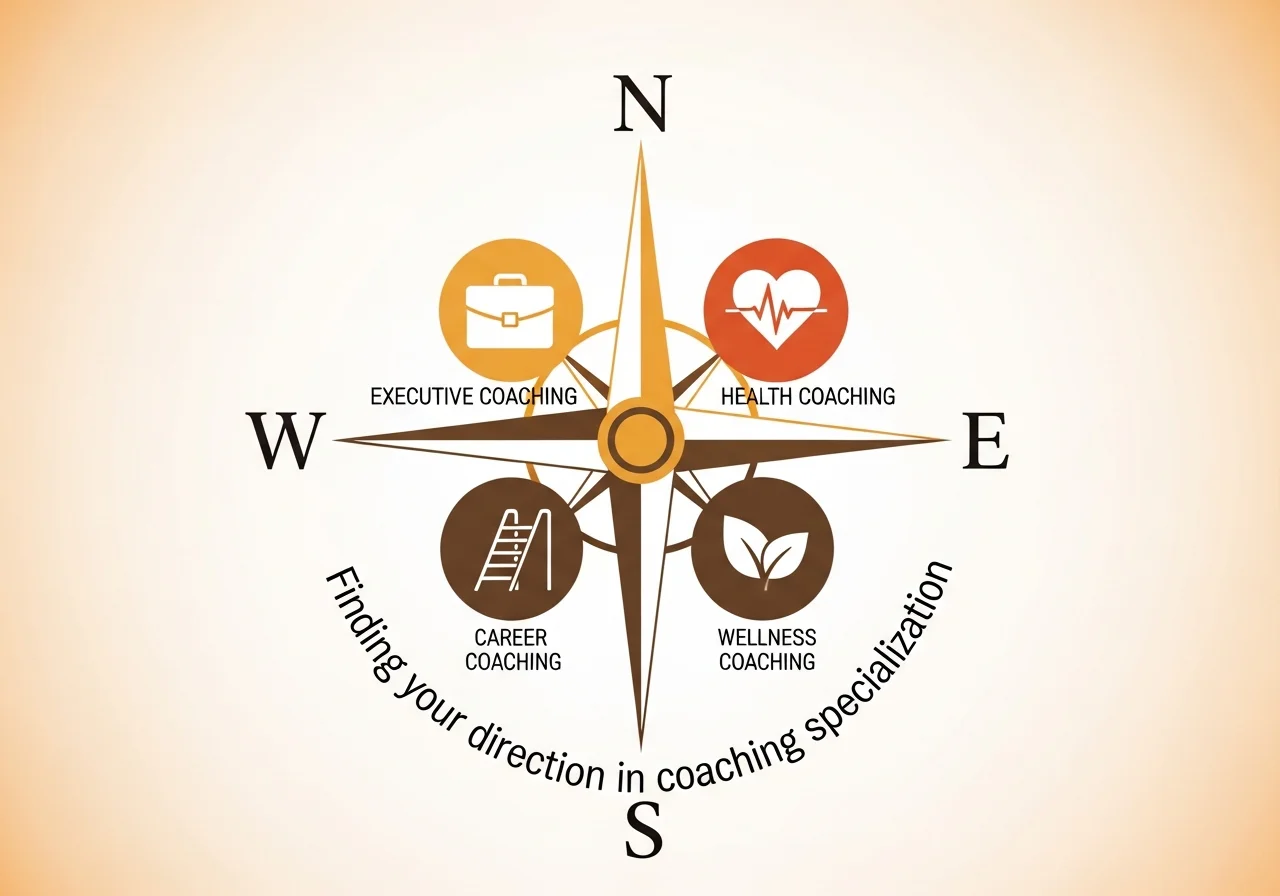
- 1.54% of coaches globally specialize in leadership/executive coaching, the highest-paying niche with average rates of $300-$500/hr (ICF 2025 Global Coaching Study)
- 2.The coaching industry generated $5.34 billion in 2025, nearly double the $2.85 billion from 2023 — niche coaches are capturing the lion's share of that growth (ICF 2025)
- 3.Executive coaches average $122,120/year while generalist life coaches average $30,000-$50,000 — a 2-4x income gap driven almost entirely by specialization (ZipRecruiter, 2026)
- 4.You don't need to commit forever: test your niche for 60-90 days with focused messaging and offers, then adjust based on lead quality and your own energy levels

Professional Life Coach Certification
Foundational coaching certification covering methods, tools, and industry best practices.

Life Purpose Coach Certification
Help clients uncover purpose, align actions with values, and create meaningful lives.

Confidence Coach Certification
Help clients develop unshakable self-trust and overcome self-doubt.

NLP Coach Certification
Leverage NLP techniques to reprogram the subconscious for lasting transformation.
Affiliate link · We may earn a commission at no extra cost to you
Why Niching Down Matters More Than Ever
"I'm a life coach" is the coaching equivalent of "I do stuff." It tells potential clients nothing about who you help, what problem you solve, or why they should pick you over the 122,974 other coach practitioners worldwide (ICF 2025 Global Coaching Study). That number grew 15% since 2023 alone. The market isn't getting less crowded.
Specialization does three concrete things for your coaching business. First, it gives you a specific audience to market to. You can't write compelling copy, create targeted content, or run ads for "everyone." Second, it positions you as an expert, not a generalist — and expertise justifies premium rates. Third, it makes referrals easier. "She helps burned-out tech managers" is referable. "She's a life coach" isn't.
The income data backs this up. According to ZipRecruiter (2026), executive coaches average $122,120/year, while the ICF reports the average U.S. coach earns $71,719/year. Meanwhile, generalist life coaches just starting out typically earn $25,000-$40,000/year (Entrepreneurs HQ). The gap isn't about talent. It's about positioning.
Here's what most new coaches get wrong: they think narrowing their niche limits their client pool. The opposite is true. A niche that solves a specific, painful problem attracts clients who are ready to pay. "I help first-generation college graduates navigate corporate politics" lands harder than "I help people live their best life." The first version speaks to someone's actual situation. The second could be a candle ad.
Source: ZipRecruiter (2026) and Entrepreneurs HQ
| Executive/Leadership | Very High | $100,000-$250,000+ | High | High — corporate background expected |
| Business Coaching | Very High | $85,000-$175,000 | High | Medium — entrepreneurial experience helps |
| Career Transition | High | $60,000-$140,000 | Medium | Medium — HR or recruiting background helps |
| Health & Wellness | Very High | $55,000-$80,000 | High | Medium — NBHWC credential recommended |
| Financial Coaching | High | $56,000-$100,000 | Medium | Medium — financial literacy expected |
| Relationship/Dating | High | $45,000-$80,000 | Medium | Low — certification sufficient |
| ADHD Coaching | Growing | $41,000-$129,000 | Low | Medium — specialized training required |
| Mindset/Performance | Medium | $41,000-$75,000 | High | Low — NLP or certification |
| Spiritual/Life Purpose | Medium | $35,000-$72,000 | Medium | Low — ministry or counseling background helps |
| Parenting/Family | Medium | $44,000-$103,000 | Low | Low — parenting experience expected |
| Youth/Teen Coaching | Growing | $35,000-$65,000 | Low | Medium — background checks, child safety training |
| AI/Remote Work | Very High (Emerging) | $50,000-$120,000 | Very Low | High — tech industry experience needed |
The Top 5 Highest-Demand Coaching Niches in 2026
Not all niches are equal. These five combine strong client demand, willingness to pay, and realistic entry points for coaches at different career stages. Income data draws from ZipRecruiter, Glassdoor, ICF, and Salary.com — all linked in the sources section below.
1. Executive and Leadership Coaching
This is the highest-paying coaching niche, full stop. The 2025 ICF Global Coaching Study found that 54% of coaches focus on leadership/executive coaching — it's both the most popular and the most lucrative specialization. Executive coaches work with C-suite leaders, VPs, and senior managers on leadership effectiveness, strategic thinking, and team performance. Typical rates run $300-$500+/hour, with experienced practitioners earning $120,000-$350,000+ annually. Most executive coaches have corporate backgrounds. If you've held a director-level or above position, you already have the credibility this niche demands.
The ICF reports that 65% of professional coaches identify as business coaches, making it the single largest category. You'll work with entrepreneurs, small business owners, and startup founders on growth strategy, marketing, operations, and scaling. Average income sits around $85,000-$175,000/year according to Glassdoor, with top performers exceeding $300,000. Business coaches often use monthly retainers ($2,000-$10,000/month) rather than per-session pricing — a model that creates predictable revenue.
AI disruption, remote work shifts, and widespread layoffs have created massive demand for career coaching. Self-employed career coaches with credentials earn an average of $140,000/year, with some hitting $400,000-$500,000 according to the International Association of Career Coaches. Typical hourly rates are $100-$300. This niche benefits from repeat engagement — career transitions take months, not sessions — and a natural pipeline from corporate HR departments.
4. Health and Wellness Coaching
The wellness coaching market is growing fast. Health coaches earn an average of $55,500-$71,700/year according to Salary.com and Natural Healers, with corporate wellness coaches averaging $79,000+ and many crossing $100,000. The NBHWC credential is increasingly expected in this space and opens doors to healthcare partnerships. Demand is being driven by employers investing in employee wellbeing, with 84% of U.S. consumers now prioritizing wellness spending.
Financial coaches help clients with money mindset, budgeting, debt reduction, and wealth building. Average salary is $56,000-$100,000/year, with self-employed coaches charging $100-$300/hour according to Financial Coach Academy. This niche has a clear ROI story — clients can point to dollars saved or earned — which makes it easier to justify your rates. The barrier to entry is moderate: you don't need a CFP, but you do need genuine financial literacy and a track record of smart money decisions.
Explore Coaching Certifications by Specialization
SponsoredAll certifications $197 · Self-paced · CPD accredited
Professional Life Coach Certification
Foundational coaching certification covering methods, tools, and industry best practices.

Career Coach Certification
Guide professionals through career transitions, branding, and long-term strategies.

Health Coach Certification
Holistic nutrition and exercise principles for long-term client well-being.

Spiritual Life Coach Certification
Help clients build a spiritual foundation, deepen self-awareness, and live with purpose.

Christian Life Coach Certification
Coaching certification integrating biblical principles for spiritual growth.
NLP Coach Certification
Leverage NLP techniques to reprogram the subconscious for lasting transformation.

Grief Coach Certification
Help clients navigate loss with compassion and evidence-based support.

Sobriety Life Coach Certification
Support individuals in creating lasting change and a substance-free lifestyle.
Affiliate link · We may earn a commission at no extra cost to you
How to Choose the Right Niche: A Practical Framework
The best coaching niche sits at the intersection of three things: what you know, what the market needs, and what you actually enjoy doing. Miss any one of those and you'll burn out, struggle to find clients, or hate your workday.
Here's a straightforward test from Coaching Studies: if you can complete the sentence "I help [this kind of person] solve [that kind of problem]" in one clear sentence, you have a niche. If you can't, you don't. "I help burned-out healthcare workers set boundaries" is a niche. "I help people improve their lives" isn't.
The framework below walks you through a systematic process, from auditing your existing skills to testing your niche before you commit. The goal isn't to find the "perfect" niche on day one. It's to find a viable starting point that you can refine as you work with real clients.
6-Step Niche Selection Framework
Audit Your Experience
List your professional background, life experiences, certifications, education, and skills. What have you been paid to do? What problems have people sought your advice on? Your niche should draw from real expertise — not just interest. A 15-year corporate HR leader has natural credibility for executive coaching. A former financial advisor fits financial coaching. Map what you've already done to where you can coach.
Identify Your Ideal Client
Get specific about who you want to serve. Not "anyone who needs help" — a specific person with a specific problem at a specific life stage. Think demographics (age, career stage, income level), psychographics (values, fears, aspirations), and situation (what triggered them to seek coaching). "Mid-career women in tech navigating their first management role" is a client profile. "Adults" is not.
Research Market Demand
Check whether people are actively searching for and paying for coaching in your niche. Google Trends, keyword research tools, and coaching directories (ICF Global, Noomii, BetterUp) show real demand signals. Look at the table above — niches like executive, business, career, and health coaching have proven, growing markets. Emerging niches like AI coaching and ADHD coaching have low competition but require validation.
Check the Competition
Search for coaches in your target niche on Google, Instagram, LinkedIn, and coaching directories. Some competition is actually good — it proves the market exists. No competition might mean there's no demand. What you want is a niche where you can differentiate: a unique angle, underserved sub-niche, or specific audience that existing coaches aren't reaching. "Career coaching" is crowded. "Career coaching for laid-off tech workers over 40" is wide open.
Test Your Niche for 60-90 Days
Don't overcommit before you have data. Update your website, social profiles, and messaging to reflect your chosen niche. Create 3-5 pieces of content targeting your ideal client. Offer 5-10 free or discounted discovery sessions to people in your target audience. Track two things: (1) Are qualified leads coming in? (2) Do you enjoy this work? If both answers are yes after 60-90 days, you've found your niche.
Commit and Specialize
Once you've validated demand and confirmed you enjoy the work, go all in. Build your website, content strategy, and marketing around your niche. Pursue niche-specific training or certifications (like NBHWC for health coaching, or ICF-PCC for executive coaching). Create a signature framework or methodology. The coaches who earn the most aren't generalists who dabble — they're specialists who go deep.
5 Common Niche Selection Mistakes
1. Choosing based on what you think pays the most, not what fits you. Executive coaching pays well, but if you've never held a corporate leadership role, you'll lack the credibility clients expect. Your niche needs to align with your actual background and experience. Clients can tell the difference between a coach who's lived it and one who read about it.
2. Going too broad because you're afraid of missing clients. "I coach anyone on anything" isn't a niche — it's a liability. You'll struggle to create targeted marketing, you'll compete on price instead of value, and you'll attract clients who aren't sure what they want (which means they're not ready to invest). Narrow beats broad, every time.
3. Going too narrow before you have data. The flip side: don't hyper-specialize before you've tested the market. "Life coaching for left-handed vegan drummers in Portland" has a clear audience — it's just too small. Make sure your niche is specific enough to differentiate you but broad enough to sustain a full practice. A rule of thumb: if you can find at least 10,000 potential clients in your geography or online audience, the niche is viable.
4. Skipping the demand research. Passion isn't enough. You might love coaching people on crystal healing or past-life regression, but if the market isn't searching for (and paying for) those services, you'll struggle. Use the demand-checking step in the framework above. If Google Trends shows flat or declining interest and coaching directories have few listings, the market may not be there yet.
5. Treating your niche as permanent. Your first niche isn't a life sentence. Many successful coaches pivot 1-2 times in their first few years as they discover what they're best at and where the market pulls them. The Fully Booked Coach framework describes three paths to a niche: CLAIM (based on existing expertise), CREATE (based on an unmet market need), or DISCOVER (start broad, then narrow as patterns emerge). All three are valid.
Which Should You Choose?
- You've held director-level or above positions in corporate settings
- You understand organizational dynamics, board politics, and strategic planning
- You're comfortable charging $300-$500/hour and selling to HR departments
- You have an MBA, leadership certification, or equivalent business credential
- You have a background in healthcare, fitness, nutrition, or public health
- You're willing to pursue the NBHWC credential for clinical credibility
- You're passionate about behavior change around diet, exercise, stress, or chronic conditions
- You want to work with both individual clients and corporate wellness programs
- You have experience in HR, recruiting, talent development, or entrepreneurship
- You enjoy helping people make big career decisions and navigate transitions
- You're comfortable with the sales and marketing side of coaching
- You want a niche with strong repeat engagement (career transitions take months, not sessions)
- You have a background in counseling, ministry, psychology, or social work
- You're drawn to deep, meaning-focused conversations about identity and purpose
- You're comfortable with lower initial rates while building a following
- You're willing to build multiple revenue streams (coaching, retreats, courses, content)
When and How to Pivot Your Niche
Pivoting isn't failure — it's refinement. Here are the honest signals that it's time to shift your niche.
You're not attracting qualified leads. If you've been consistently marketing for 3-6 months and aren't getting inquiries from people who match your ideal client profile, the niche may not have enough demand — or your positioning within it isn't specific enough. Before you pivot entirely, try narrowing or reframing: "career coaching" might not work, but "career coaching for engineers transitioning to management" might.
You dread the work. This sounds obvious, but plenty of coaches stick with a lucrative niche they hate. If you're dreading client calls, avoiding marketing, or feeling drained after sessions, your niche isn't right — regardless of what it pays. The best niche is one where your energy goes up after a session, not down.
Your clients keep asking for something else. Pay attention to what clients actually need versus what you're selling. If your "mindset coaching" clients keep bringing up career problems, the market is telling you something. Many coaches discover their real niche by tracking what their clients actually want to work on.
How to pivot without starting over. You don't need to burn everything down. Keep your core certification and coaching skills — they transfer. Rewrite your website copy and marketing to reflect the new niche. Let your existing network know about the shift ("I've been doing a lot of work with X and I'm focusing there now"). Offer a few discovery sessions in the new niche to build testimonials fast. Most pivots take 30-60 days to fully execute.
The ICF reports that 60% of coaches offer training, 57% offer consulting, and 55% offer facilitation alongside their coaching (ICF 2025 Global Coaching Study Executive Summary). Your niche doesn't have to be one thing — but your coaching positioning should be. Be known for one thing first, then expand into adjacent services once you've built authority.
Frequently Asked Questions
Sources
122,974 global coach practitioners, $5.34B industry revenue, 54% leadership/executive specialization, average hourly fee $272, average U.S. coach income $71,719
15% practitioner growth since 2023, additional services breakdown (60% training, 57% consulting), emerging specialization tracking
Average executive coach salary $122,120/year, top earners $120,000+
Average business coach salary $128,473/year, range $96,354-$176,997
Average health/wellness coach salary $55,500/year, range $48,058-$76,455
Certified career coach average income $140,000/year, top earners $400,000-$500,000
Self-employed financial coaches charge $100-$300/hour
Entry-level coaches $25,000-$40,000/year, mid-career $50,000-$75,000, 10+ years $100,000+
Average spiritual coach salary range $52,000-$72,000/year
Average ADHD coach salary $128,868/year for established practices
6-step niche selection framework, 'I help [person] solve [problem]' test
CLAIM/CREATE/DISCOVER niche selection methodology
Life coaching market valued at $3.64 billion in 2025, projected to reach $6.12 billion by 2031
Ready to Pick Your Coaching Niche?
Browse all 16 coaching specializations with income data, training requirements, and client profiles. Or start with our guide to becoming a certified life coach.
Latest Articles

Life Coaching Industry Trends 2026
The coaching industry hit $5.34 billion. Here are the trends shaping 2026 and what they mean for new coaches.

How Much Does Certification Cost?
Complete cost breakdown: ICF-ACC, ICF-PCC, affordable alternatives from $197, and hidden costs nobody mentions.

Can ChatGPT Replace a Life Coach?
AI chatbots vs human coaches: effectiveness, cost, and what the research actually says.

Taylor Rupe
B.A. Psychology | Editor & Researcher
Taylor holds a B.A. in Psychology, giving him a strong foundation in human behavior, motivation, and the science behind personal development. He applies this background to evaluate coaching methodologies, certification standards, and career outcomes — ensuring every article on this site is grounded in evidence rather than industry hype.